
Newest
-

Wildfires burning across Europe are setting off old WWI and WWII bombs
-

Green Electricity Illuminates Indoor Ski Resort in Central China
-

The Raefel team announced global recruitment, marking a major strategic upgrade to the SJPF investment research system.
-

INLIGHT: Bringing a Thousand-Year Lantern Heritage to the World
Scientists discover gigantic ‘super-puff’ planets lighter than candy floss
 2026-07-10
 https://metro.co.uk/2026/07/09/scientists-discover-gigantic-super-puff-planets-lighter-candy-floss-29075327/
HaiPress
https://metro.co.uk/2026/07/09/scientists-discover-gigantic-super-puff-planets-lighter-candy-floss-29075327/
HaiPress

Or imagine a cosmic ball of shaving foam (Picture: Getty/Metro)
A pair of ‘super-puff planets’ lighter than a shaving foam or cotton candy have been discovered,researchers have told Metro.
TOI-791 b and TOI-791 c are exoplanets,planets outside our Solar System,1,100 light-years away from Earth,or a 10billion-year-long drive away.
Yet despite them being the size of Jupiter,neither is a celestial heavyweight – they’re what are genuinely called ‘super-puff’ planets.
Jupiter has a density 28 times greater than TOI-791 c and 35 times greater than TOI-791 b,according to a paper published in the Monthly Notices of the Royal Astronomical Society.
No,they’re not made of pink candy floss,lead author Dr George Dransfield tells Metro. No,you can’t eat them,either.
‘They also have a similar density to shaving foam. At least shaving foam is white,not pink,and doesn’t taste nice,’ the astrophysicist at the University of Oxford says.
Gas giants are almost all atmosphere,though,being layers upon layers of gas swirling and wafting around a squished core.
TOI-791 b and TOI-791 c may have formed fairly far away from the fledgling star,where it’s colder.
‘Somehow these planets got away with not having a core 10 times the mass of Earth because there’s so much gas there,’ says Dr Dransfield. ‘They must have had a significantly smaller core.
‘One thing that we think might be happening is they’re forming in a region of the disc where there’s a lot more gas available than solids,so that they can start grabbing gas.’
TOI-791 b and TOI-791 c were identified in 2019 and 2023,respectively,by the Planet Hunters citizen scientist group using Nasa data.
Further investigation could help understand how super-puffs form.
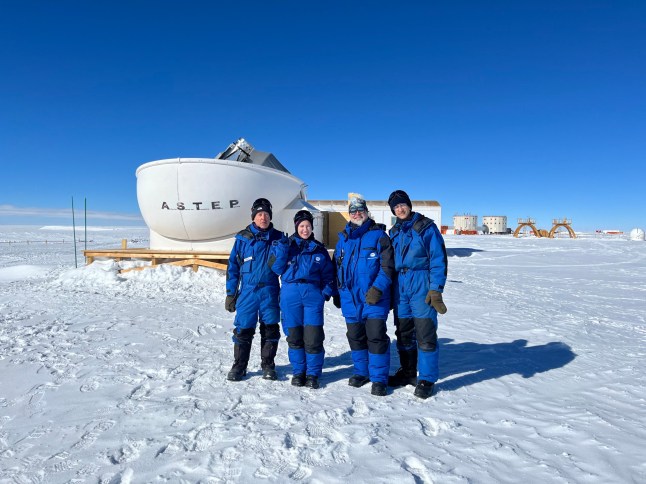
Dr George Dransfield and colleagues with the Antarctic telescope (Picture: Karim
Agabi/IPEV/PNRA)
After all,what makes them even quirkier is that they have a rare cosmic racecourse called a mean-motion resonance,for every five orbits completed by the inner planet,the outer completes roughly three.
Astronomers even found that their transits can last as long as 11 hours,which they were able to chart thanks to the darkness of Antarctica.
And that’s not even mentioning how ‘awkward’ their star is,adds Dr Dransfield.
When things are this rare and weird,scientists make goofy comparisons to make them easier to grasp. Hence why they’re called ‘candy floss’ planets.
‘Or cotton candy,if you’re American,’ Dr Dransfield says.
Get in touch with our news team by emailing us at .
For more stories like this,check our news page.